
Revision Rhinoplasty Bellevue
Revision rhinoplasty in Bellevue is a corrective and reconstructive nasal surgery performed after a previous rhinoplasty has not produced the desired aesthetic or functional result.
 [ PROCEDURE · OVERVIEW ]
 What is Revision Rhinoplasty Bellevue?
A revision rhinoplasty is any rhinoplasty performed after a previous nasal surgery. The procedure may address a small isolated concern — a residual dorsal hump, a tip asymmetry, a breathing issue — or it may be a more comprehensive reconstruction in cases where the prior surgery removed too much structure. Common revision indications include:
- Aesthetic concerns: asymmetric tip, persistent or recurrent dorsal hump, scooped or "ski slope" dorsum from over-resection, pinched or pollybeak appearance, or a tip that does not match the rest of the nose
- Functional concerns: internal nasal valve collapse, external valve compromise, persistent septal deviation, or new airway obstruction that developed after the primary procedure
- Combined aesthetic and functional concerns — the most common revision presentation
For Bellevue and Eastside patients, the practical clinical picture is this: revision rhinoplasty is a different surgical category from primary rhinoplasty. The internal anatomy has been altered, the cartilage and bone may be partially resected, scar tissue replaces normal tissue planes, and the surgical decision-making must respect what the prior procedure removed and what remains. Albert Yang, MD's approach in Bellevue mirrors the standard contemporary revision-rhinoplasty framework described in current peer-reviewed facial plastic surgery literature: open structural approach in most revision cases, targeted use of cartilage grafts (rib, ear conchal, or septal where remaining), and reconstruction-minded decision-making rather than further resection.
Ideal Candidates
Revision rhinoplasty in Bellevue is best suited for patients who are at least 12 to 18 months past their previous rhinoplasty, who have a clear, articulable concern about the current result, and who have realistic expectations about what a second surgery can achieve. Clear candidacy signals include:
- Time elapsed since prior surgery: typically a minimum of 12 to 18 months to allow swelling to fully resolve and tissue to settle
- A specific, articulable concern (asymmetry, hump, tip shape, breathing) — rather than a vague dissatisfaction
- Reasonable health and surgical fitness
- Realistic expectations about the limits of revision surgery, including the realities of working through scar tissue
- Willingness to accept that revision rhinoplasty has higher complexity and longer recovery than primary rhinoplasty
Good candidates do not smoke (or are willing to stop several weeks before and after surgery), have a stable medical status, and have processed the emotional weight of a prior surgical experience.
Revision rhinoplasty is not appropriate for every patient. Patients who are within the first year of their primary surgery — when residual swelling can mimic structural problems — are typically deferred. Patients with body dysmorphic concerns or with a pattern of rapid post-operative dissatisfaction across multiple procedures are not candidates and are referred for appropriate care. Patients seeking changes that are anatomically impossible given what the prior surgery left to work with are candid declines. The consultation in Bellevue is structured to identify the right plan honestly — including recommending against further surgery when that is the better answer.
The Procedure & Technique
Revision rhinoplasty at the Bellevue practice is typically performed under general anesthesia in an accredited surgical facility. The procedure typically takes 3 to 5 hours — meaningfully longer than a primary rhinoplasty — because of the time required to work through scar tissue, harvest grafts, and rebuild structure rather than reduce it.
Most revision rhinoplasty cases use an open approach (a small inverted-V incision across the columella plus internal incisions inside the nostrils) for two reasons: open exposure provides direct visualization of the altered internal anatomy, which is essential when scar tissue and prior alterations have changed the normal anatomic landmarks; and open exposure allows precise placement of cartilage grafts under direct vision, which is the foundation of structural revision work.
The technical core of revision rhinoplasty is structural reconstruction with cartilage grafts. Common graft sources include:
- Septal cartilage — when sufficient septum remains from the primary surgery, this is the preferred graft material because of its strength, ease of carving, and donor-site simplicity
- Auricular (ear) conchal cartilage — used when septal cartilage is insufficient; provides moderate amounts of softer, curved cartilage well-suited for tip and lateral wall grafts
- Costal (rib) cartilage — used when larger volumes of strong, straight cartilage are needed, particularly for dorsal augmentation or major structural reconstruction. Rib cartilage requires a separate harvest incision (typically near the inframammary fold)
Common revision techniques include spreader grafts (placed between the upper lateral cartilages and the dorsal septum to support the internal nasal valve and address dorsal aesthetic-line irregularities), tip grafts (refining or strengthening the tip), alar batten or rim grafts (supporting the external nasal valve to prevent or correct collapse), dorsal augmentation grafts (for over-resected dorsa), and caudal septal extension grafts (to support and reposition the tip).
Albert Yang, MD's approach in Bellevue mirrors this contemporary structural revision framework. The defining principle is reconstructive: revision rhinoplasty rebuilds with grafts rather than removing more tissue, because most revision concerns are the result of insufficient structural support after the primary procedure.
Considering Revision Rhinoplasty Bellevue in Bellevue?
Recovery & Timeline
Recovery from a revision rhinoplasty is generally similar to a primary rhinoplasty — but slightly longer in the swelling-resolution arc, because revision work involves more scar tissue and (in many cases) graft incorporation. The general timeline most Bellevue and Eastside patients can plan around is:
- Day 0–7: External splint or cast in place. Internal splints (when used) are typically removed at the first post-op visit. Mild to moderate swelling and bruising of the lower face. Pain is typically low and well-managed with prescribed medication.
- Day 7–10: First major post-op visit. External splint is removed. Internal splints come out. Most external bruising has resolved or is camouflage-able.
- Day 10–14: Most patients return to office-based work. Residual swelling is significant in the tip and along the dorsum. Glasses should be supported off the bridge for several weeks.
- Week 3–4: Bruising fully resolved. Swelling significantly down but still present, particularly in the tip. The nose looks "good but not final."
- Week 6–8: Light exercise can resume. The nose looks substantially settled.
- Month 3–6: Significant swelling resolution. Final shape begins to emerge.
- Month 6–12: The tip continues to refine. Most patients see meaningful changes between months 6 and 12.
- Year 1–2: Full settling. Revision rhinoplasty results are considered final at approximately 18 to 24 months — slightly longer than primary rhinoplasty, because of the graft-incorporation arc.
If rib cartilage was harvested, the rib donor site has its own short-arc recovery: mild discomfort for the first 1–2 weeks, fully resolved within 4–6 weeks. The donor scar is typically a fine line in a well-hidden location.
Bellevue patients are typically seen at 1 week, 2 weeks, 6 weeks, 3 months, 6 months, 12 months, and 18–24 months for in-person follow-ups, with virtual touchpoints between visits as appropriate. Long-term follow-up matters more in revision than primary cases.
 [ EXPECTED RESULTS ]
 Expected Results
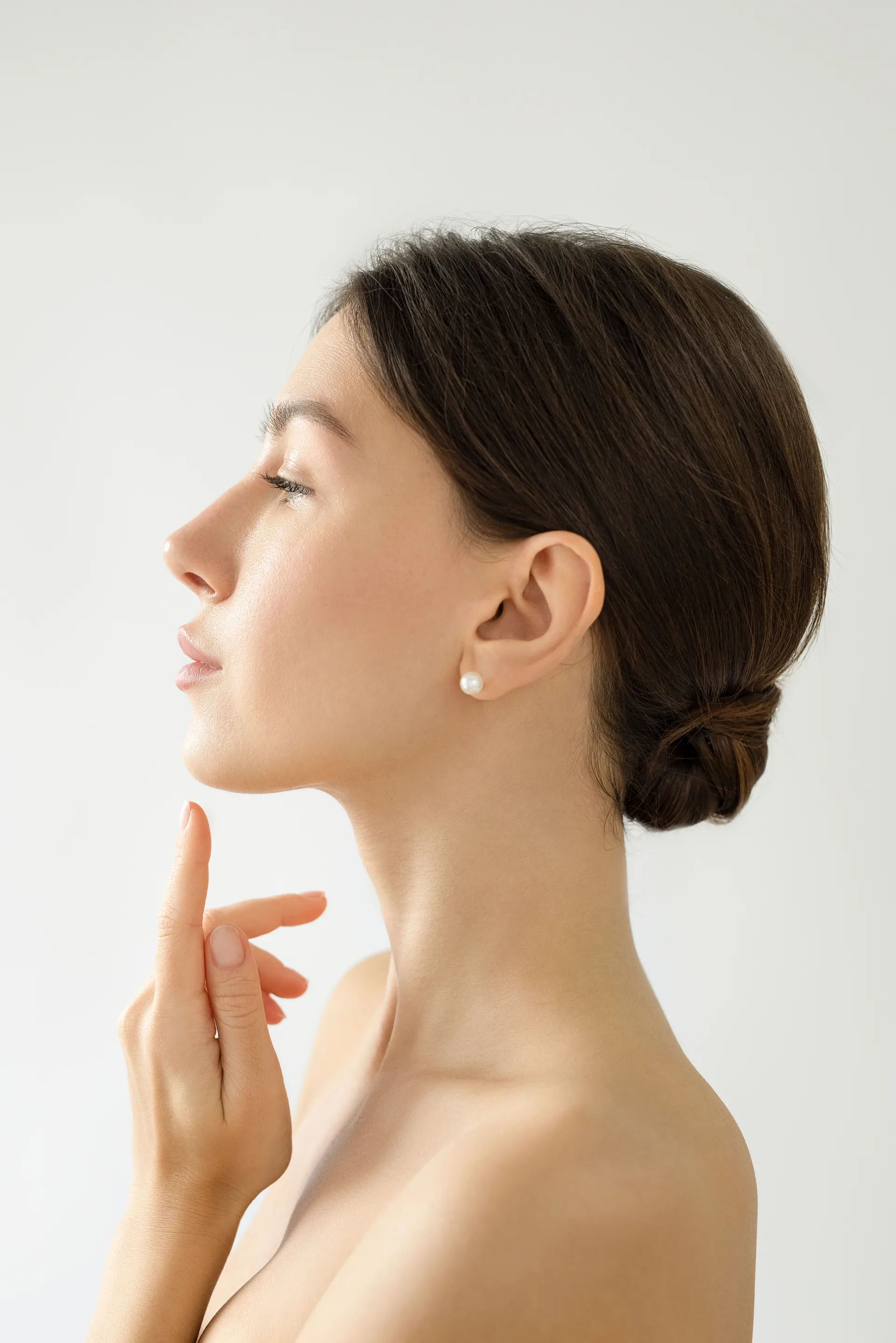
A well-executed revision rhinoplasty produces a more refined, more natural-looking, and (when functional concerns are addressed) better-breathing nose than the result of the primary surgery. Most patients experience meaningful improvement in the specific concern that brought them in, along with a more durable result that holds up over time because the structural reconstruction is supported by appropriately placed grafts.
Honest framing on outcomes is important. Revision rhinoplasty is technically more difficult than primary rhinoplasty, and the results are also generally less precisely predictable, because the surgeon is working through scar tissue with anatomy that has been altered. The realistic goal is substantial improvement of the specific concern rather than perfection. Patients undergoing revision rhinoplasty often arrive having lived with disappointment, and the consultation specifically addresses the gap between "improved" and "perfect."
Longevity is meaningfully better in structural revision work than in revisions that remove more tissue. By rebuilding with grafts, the new shape is supported by structural cartilage rather than by skin tension or scar contraction — both of which fail over time. Most patients see results that read natural at 12 to 18 months and continue to look correct for the long term.
Revision rhinoplasty does not always achieve a single-stage solution. In a small percentage of cases, a third procedure may be considered — usually a small refinement rather than a major surgery. Patients seeking comprehensive nasal care often consider Rhinoplasty framing for general nasal surgery education, Open Rhinoplasty for technical comparison, or Ethnic Rhinoplasty when the revision context includes ethnic-specific anatomic concerns.
Risks & Considerations
Every surgical procedure carries risk, and revision rhinoplasty carries a higher risk profile than primary rhinoplasty. Most complications are minor and manageable; a few deserve explicit acknowledgment because of the revision context. Possible risks include:
- Imperfect or partial correction — revision results are less precisely predictable than primary results because scar tissue and altered anatomy reduce surgical precision
- Need for further revision — a small percentage of revision cases benefit from an additional small refinement procedure
- Infection — uncommon but slightly higher in revision than primary cases, particularly with rib graft harvest
- Bleeding and hematoma — uncommon
- Skin necrosis — rare; risk is significantly higher in active smokers and in cases with very thin skin from prior surgery
- Graft warping, displacement, or visibility — particular consideration with rib grafts, which can warp over time; minimized by appropriate carving technique
- Rib donor site issues — small pneumothorax risk (rare), rib donor scar
- Persistent breathing concerns — when revision is performed for functional reasons, there is no guarantee of complete resolution
- Asymmetry — minor asymmetry is common; significant asymmetry is uncommon
- Anesthesia-related risks — discussed separately at the pre-op visit
- Persistent or recurring cosmetic concerns — minimized by candid pre-operative discussion of what is and isn't anatomically achievable
Risk discussion is an extended conversation in revision rhinoplasty consultations in Bellevue. Dr. Yang's approach is to be candid about the higher complexity and the slightly less precise predictability of revision results — the patient deserves to understand the difference before consenting to a second surgery.
Questions about Revision Rhinoplasty Bellevue?
Talk with Dr. Yang.
Frequently Asked Questions
How long should I wait after my primary rhinoplasty before considering a revision?+
Most surgeons recommend waiting at least 12 to 18 months after primary rhinoplasty before considering a revision. The reason is that residual swelling — particularly in the tip and along the dorsum — can persist for many months and can mimic or exaggerate apparent structural problems. What looks like a tip irregularity at month 6 may have resolved by month 14. Waiting also allows the surgeon performing the revision to work on tissue that has fully settled rather than tissue still in active resolution.
What makes revision rhinoplasty more difficult than primary rhinoplasty?+
Three things. First, scar tissue replaces normal tissue planes, which makes dissection harder and reduces precision. Second, structural cartilage may have been partially resected during the primary procedure, which means the revision often requires harvested grafts (ear conchal or rib) rather than working with what's already there. Third, the patient has often lived with disappointment, which means expectations and emotional considerations are different from a primary case. All three considerations extend the consultation, the procedure, and the recovery.
Where will the cartilage grafts come from?+
It depends on what is needed. When sufficient septal cartilage remains from the primary surgery, the septum is the preferred source. When more or stronger cartilage is needed, ear conchal cartilage (donor scar hidden behind the ear) or rib cartilage (donor scar typically near the inframammary fold) can be harvested. The graft source is decided at the consultation based on the structural reconstruction the revision requires.
Will revision rhinoplasty fix my breathing problems?+
Often yes, when the breathing concerns are caused by structural compromise from the primary surgery — internal valve collapse, persistent septal deviation, or external valve weakness. Revision rhinoplasty in these cases typically involves spreader grafts, batten grafts, or septal reconstruction. Patients undergoing revision for functional concerns alone may have insurance coverage; cosmetic-only revisions typically do not. The consultation in Bellevue addresses both functional and aesthetic concerns together.
When can I return to work after revision rhinoplasty?+
Most patients return to office-based, non-physical work in 10 to 14 days. Bruising is usually camouflage-able by day 10–14; residual swelling is normal but generally not socially obvious. The external splint comes off at the day-7 visit; glasses should be supported off the nasal bridge for approximately 4 to 6 weeks.
Will the revision rhinoplasty result be visible immediately after the splint is removed?+
No. The result emerges slowly over many months. Initial post-splint appearance includes significant residual swelling, particularly in the tip and along the dorsum. Meaningful refinement continues through 6 to 12 months, and revision rhinoplasty results are considered final at approximately 18 to 24 months. Patience during the settling arc is part of the procedure.
Could I need a second revision?+
A small percentage of revision rhinoplasty cases benefit from an additional small refinement procedure. This is typically a minor in-office or short outpatient touch-up rather than another major surgery. The likelihood is discussed candidly at the consultation and is one reason the goal of revision rhinoplasty is "substantial improvement" rather than "perfection."
Serving Bellevue & the Eastside
Bellevue+
The Bellevue practice is the home base for revision rhinoplasty across the Eastside. With a 0-minute drive time for in-city patients, the clinic at 15600 NE 8th St, Suite A-8 is convenient for the longer-arc follow-up schedule revision rhinoplasty requires — pre-operative imaging review, surgery day, splint removal at week 1, and the extended 1-week, 2-week, 6-week, 3-month, 6-month, 12-month, and 18-month visits. Bellevue patients also benefit from the unhurried in-person consultation, which for revision rhinoplasty often runs longer than a primary rhinoplasty consultation.
Clyde Hill+
Clyde Hill patients reach the Bellevue clinic in approximately 5 to 8 minutes via Bellevue Way and 92nd Ave NE. The short drive matters for revision rhinoplasty's long-tail follow-up schedule, where small tip and dorsum refinements are tracked over many months. Clyde Hill patients can typically combine post-op visits with everyday errands in downtown Bellevue. The procedure itself is performed at the Bellevue clinic by Dr. Yang.
Medina+
Medina patients reach the Bellevue clinic in approximately 5 to 8 minutes via 84th Ave NE and Bellevue Way. The proximity is particularly valuable for revision rhinoplasty's extended follow-up cadence, including the 18-month visit at which the result is considered final. Medina patients often combine consultation visits and post-op follow-ups with other downtown Bellevue errands. The revision rhinoplasty itself is performed in Bellevue by Dr. Yang.
Issaquah+
Issaquah is approximately 15 to 20 minutes from the Bellevue clinic via I-90 — the longest regular drive among the practice's service areas. Issaquah patients undergoing revision rhinoplasty typically plan to stay closer to Bellevue on the night of surgery, given the 3–5 hour procedure length and the value of close monitoring on day 1. Subsequent follow-ups are scheduled with Issaquah commute patterns in mind, and a hybrid in-person and virtual cadence reduces drive volume during the 12 to 18-month revision-rhinoplasty settling window.
Mercer Island+
Mercer Island patients reach the Bellevue clinic in approximately 8 to 12 minutes via I-90 outside of rush hour. For Mercer Island patients undergoing revision rhinoplasty, the multi-month post-op follow-up schedule is the practical question — and the cross-bridge drive is short enough that the standing visit cadence (1 week, 2 weeks, 6 weeks, 3 months, 6 months, 12 months, 18+ months) remains entirely manageable. Virtual touchpoints between in-person visits help reduce drive volume during the long settling period.
Sammamish+
Sammamish patients reach the Bellevue clinic in approximately 12 to 18 minutes, depending on traffic on I-90 or SR-520. For Sammamish patients undergoing revision rhinoplasty, planning is the key: consultations and pre-op visits are often combined into a single trip, and a hybrid mix of in-person and virtual follow-ups reduces the number of round-trip drives during the 12 to 18-month settling window. Many Sammamish patients specifically choose the Bellevue practice for fellowship-trained revision rhinoplasty expertise.
Redmond+
Redmond patients reach the Bellevue clinic in approximately 12 to 15 minutes via SR-520 or Bel-Red Rd. For Redmond patients undergoing revision rhinoplasty, mid-morning and early-afternoon appointment slots avoid the heaviest cross-Eastside commute. The procedure's typical 10–14 day return-to-office window plans well around Redmond schedules, and virtual touchpoints between in-person visits reduce drive volume during the long-arc settling period.
Yarrow Point+
Yarrow Point sits 5 to 7 minutes from the Bellevue clinic — among the closest service areas. For Yarrow Point patients undergoing revision rhinoplasty, the geographic proximity is a meaningful logistical advantage during the early splint-removal week and during the subsequent 18-month settling arc. Quick in-person check-ins for swelling assessment and tip refinement progress fit easily into a Yarrow Point schedule, and Dr. Yang's boutique revision rhinoplasty practice functions essentially as a neighborhood resource.
Hunts Point+
Hunts Point is approximately 5 to 7 minutes from the Bellevue clinic via SR-520 — one of the most convenient service areas for revision rhinoplasty's long-arc follow-up schedule. Hunts Point patients can typically come in for a quick splint removal, swelling assessment, or tip-refinement progress check and be home within the hour. Dr. Yang's single-surgeon model means the same surgeon performs the revision and conducts every follow-up — particularly important in revision rhinoplasty, where pattern recognition over the 18-month settling arc matters.
Kirkland+
Kirkland patients reach the Bellevue clinic in approximately 12 to 15 minutes via I-405. For revision rhinoplasty, Kirkland patients often specifically choose Dr. Yang because they want a fellowship-trained revision specialist — not a general primary-rhinoplasty surgeon — for what is universally acknowledged to be the more technically demanding type of nasal surgery. Recovery follow-ups are arranged in-person at the Bellevue clinic, with virtual options between visits during the 18-month settling arc.
Related Procedures
- Rhinoplasty — General overview of nasal surgery; useful framing for patients comparing primary and revision contexts.
Rhinoplasty
General overview of nasal surgery; useful framing for patients comparing primary and revision contexts.
Open Rhinoplasty
The technical approach used in most revision cases.
Ethnic Rhinoplasty
Often relevant when the revision context includes ethnic-specific anatomic concerns.
Rhinoplasty and nasal surgery
The full category of nasal surgical procedures performed at the Bellevue practice.